Posts filed under 'Types of Scholars' Rocks'

Lingbi Stone

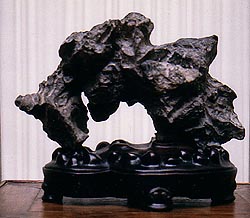
Scholar's Rock - Lingbi StoneRanked first among the four types of famous Chinese Scholars Rocks. These are found in Lingbi county of Anhui Province, China. They are fine-grained, delicately textured limestone and lie deep in the red mud of the Qingshi mountains. Naturally shaped, they need no cutting or carving. Depleted after generations of mining, high quality Lingbi are now quite rare. They are hard and an ordinary knife cannot cut them. Their mineral composition is such that they produce a metallic, resonant sound when tapped. Hence they are also called ‘resonant rocks’ (bayinshi). They were sometimes used for making chimes and are thus also known as ‘chime rocks’. Lingbi rocks are beautiful and clear-cut, with a frame of soft lines. Combining masculine beauty with antique simplicity, they have been admired by connoisseurs for centuries. In the Northern Song dynasty, Emperor Huizong wrote this inscription on one Lingbi in his collection: “The mountain is high while the moon looks small the water ebbs and the rock juts forth.”
Add comment February 7th, 2008

Taihu Stone

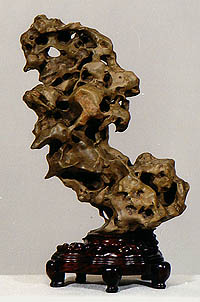
Scholar's Rock - Taihu StoneFound mostly in the vast drainage areas of Tai Lake, these limestone rocks are hard but brittle, with slight variations among those taken from lake beds and those extracted on land or from different districts in the surrounding environs. Those formed underwater are more precious, because of their fresh, soft color and their multiple, linked perforations produced from years of wave and water erosion. With their pale gray or ivory tint, Taihu rocks are usually large and are regarded as the best garden rocks. Artificial hills made of Taihu rocks give the appearance of strange peaks looming up or chains of hills connected by streams and bridges, with successive peaks along narrow, twisted paths. Small Taihu rocks of good quality are rare and meant for indoor appreciation. The beauty of Taihu rocks comes from their thinness and wrinkles as well as their as their perforations and hollows which enhance their open appearance.

Add comment February 7th, 2008

Ying Stone

Scholar's Rock - Ying StoneTradionally produced in Yingde, Guangdong province and in Guanxi province, these rocks are limestone with calcite deposits. less hard than Lingbi, they are often full of furrows with twisted lines on intricately textured surfaces. Notable for their diverse shaped, they appear to embody a thousand hills and valleys, and so are well-suited for representing a far distant landscape. Their typical thin, wrinkled appearance often exhibits traces of sawing and cutting with distinguishable front and reverse sides. The best known example is called ‘Winkling Cloud Peak’ in Hangzhou’s West lake, China.

Add comment February 7th, 2008

Muhu Black Ying Stone

Scholar's Rock - Muhu Black Ying Stone
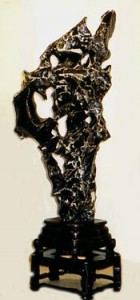
Produced in Guanxi province, muhushi resemble Taihu rocks for their thinness, perforations, wrinkles and wide variety of shapes, although their surface lines are smoother. They are gray or black, sometimes with white undercurrents. Their color is ideal for decorating interior spaces but they are not suitable for gardens as they are much smaller than Taihu rocks.

Add comment February 7th, 2008

Zibowen Stone

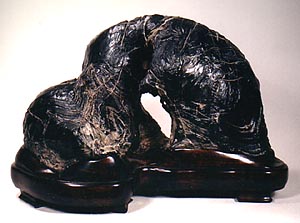
Wen rocks are found in Zibo, Shandong province. They are decayed rocks composed of lime, granite or clay stone. Aesthetically wen rocks have a naturalness and antique simplicity. They have a weathered look with dots or crossing lines on the surface and a variety of wrinkled forms. Among this type are aragonite rocks which are usually black and very hard. Wen rocks portray a feeling of “pu.”

Add comment February 7th, 2008

Yellow Wax Stone

Yellow wax rocks are found in many places in China including Guangdong, Guanxi, and Ganxu but not in great quantity. Their gentle shape and smooth texture is neither thin nor perforated, but dense. Composed either of andesite with silica or sandstone, they seem hard as jade. A distinctive feature of yellow wax rocks is their purity of color.

Add comment February 7th, 2008

Previous Posts


Welcome to Spirit-Stones.com Blog!


Contact Kemin Hu
Email: LHInc12@aol.com
Phone: 617-244-7149

Sign up for Kemin's Email Newsletter
Email:

Blogs about...

Gallery Slideshow

Get the Flash Player to see the slideshow.

Subscribe via RSS