Welcome to Spirit-stones.com’s new home!

We have updated our website to better serve your interest in Scholars’ Rocks. Our new spirit-stones.com blog will keep you informed on news, events, books and other education content on Scholars’ Rocks. Like any other blog, you can subscribe to our content feed and keep up to date automatically.

As always, you will find Scholars’ Rocks for purchase in the purchase section. Please feel free to explore the new site starting with the links on the top of the page. We realize the navigation of our new home is somewhat different from our old “red” website so please let us know what you think by writing to us with your feedback and comments. Thanks!

Best Regards,
Kemin

Add comment May 7th, 2008

2008 International Asian Art Fair - New York, NY

This year’s International Asian Art Fair (March 14 to 20th 2008) was held at 583 Park Avenue in New York City. The fair was born grand 12 years ago, and for a while grew only grander, sailing along as the flagship of Asia Week of sales and auctions in New York, and becoming a gold standard for art fairs in general.

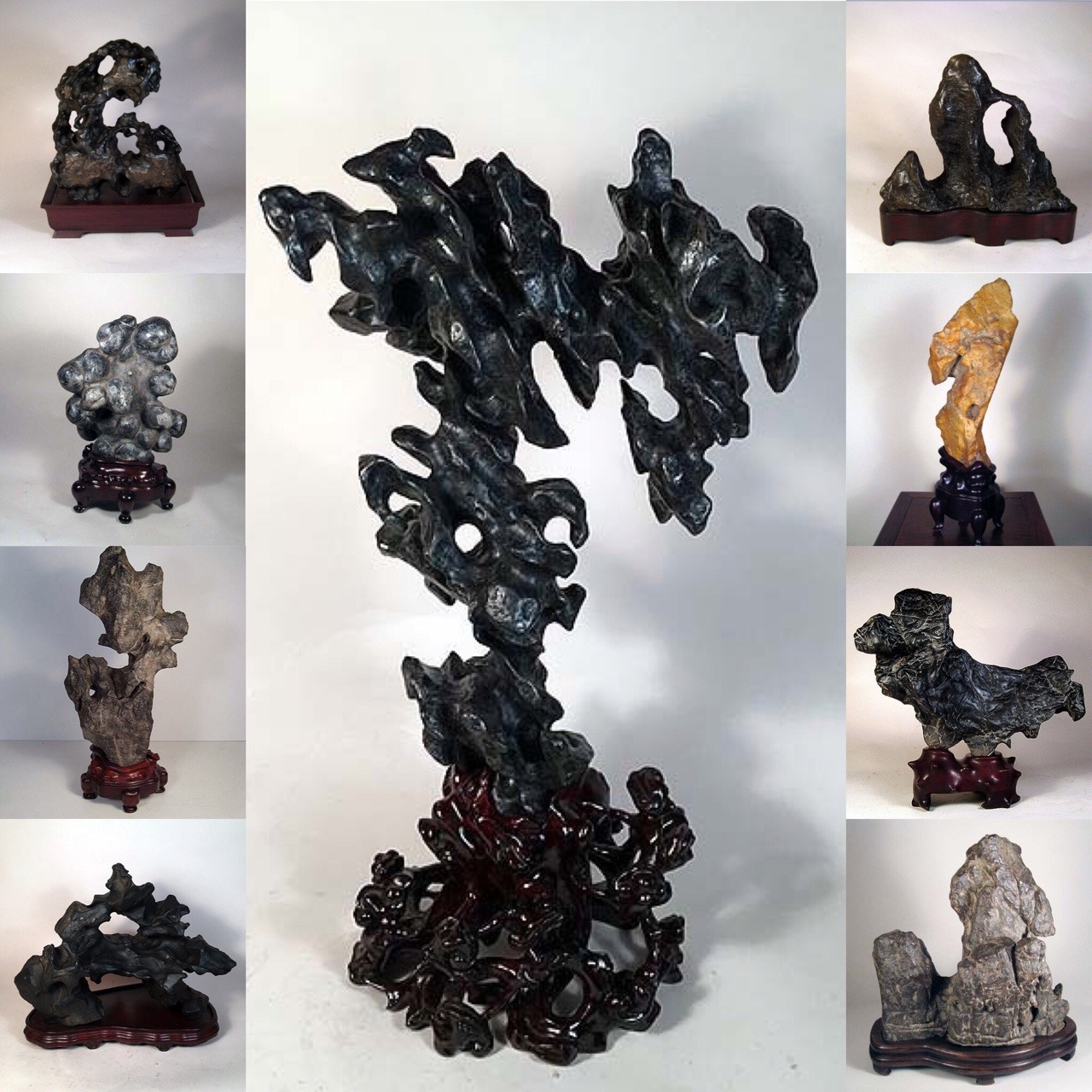
This is the third year Kemin has participated in the International Asian Arts Fair. Below are photos of this year’s booth. Many artists and celebrities like Martha Stewart stopped by to learn and admire the Scholars’ rocks display. The Lingbi Stone in the middle was sold to be displayed at a University Museum in Florida.

More Photos from the Show

Add comment March 24th, 2008

The Symbolism of Chinese Rocks - Essay by Richard Rosenblum

Richard Rosenblum The French scholar Rolf Stein stated that early Chinese believed that somewhere in the highest mountains there was a cave that was an exact representation of the world outside. In its center was a stalactite that gave off the milk of contentment. Any rock that suggests a mountain, cave or stalactite became symbolically important. This idea is reinforced by the Chinese notion that in addition to north and south, east and west, the most important orientation was ‘in’. it is because of this inward focus that Chinese culture looked for paradise inside of things, just as western culture looked upward and outside. in Chinese art, this orientation caused a search for ‘a world within a world’, for imagery in surprising and unpredictable places.

Let’s imagine that early Chinese lived in limestone caves. We know that karst limestone caves are common in China, and that among their characteristics are endlessly winding tunnels. They have underground streams and lakes, skylights, even fish. The geography of this world was so complex, that people would not be able to explore and map them in a dozen lifetimes. Paradoxically, when they emerged from these caves, they could readily see and walk around the small mountains that contained these ‘worlds within worlds’.

(more…)

Add comment March 7th, 2008

Spirit Stones - Essay by Ian Wilson

Ian Wilson‘Scholar’s rock’ is the name commonly given to gongshi in the West. I much prefer the use of ’spirit stone’ as it is more in keeping with the fundamental Chinese appreciation of their spiritual aspects. The term ’spirit stone’ also evokes the deeper Daoist symbolism that was the basis for the original interest among Tang, Song, and Ming literati in these objects. Whereas ’scholar’s rock’ reflects basic tenets of Western connoisseurship which is essentially analytical and investigative. Hence the vital role of provenance and the focus placed on appreciation of man-made objects.

Western study is objective and scientific and generally lacks or downplays the spiritual challenge of Chinese art. Thus it is difficult to appreciate objects in their natural form. New York’s Museum of Modern Art has no natural objects in their collection, and apart from a few spirit stones, The Metropolitan Museum of Art has only man-made objects. Consequently, there is a tendency to regard rocks as geological rather than spiritual objects and to appreciate them by rock type rather than for their aesthetic appeal.

(more…)

Add comment March 7th, 2008

Rare Rocks are God’s Creations - Essay by C. C. Wang

C. C. WangI began collecting rocks in my twenties, more than sixty years ago. Ever since, my interest has never diminished. Western painters use human bodies as models while we landscape painters prefer rocks. Human beings, despite differences in appearance, height, proportion and weight, are on the whole not much different from one another. Rocks come from nature, and they are God’s masterpieces, widely different in shape, material, color, texture, and, more importantly, in artistic conception and charm. To depict a rock in a landscape is to paint its bones and frame. A good landscape painter has a profound understanding of the shape and surface texture of a rock.

Chinese painting, both in past and present, focuses on texture and brushwork. Truthful depiction of landscape was valued in ancient Chinese painting from the Five dynasties (907-960) until the Yuan dynasty (1279-1368) when Ni Zan shifted the focus to use of the brush.

(more…)

Add comment March 7th, 2008

Displaying Gongshi in a Group - Essay by Hu Zhaokang

Hu ZhaokangIt is a time honored practice to display rocks in outdoor gardens or indoors on pedestals for appreciation. The great calligrapher and painter Mi Fu loved rocks to distraction. Bowing to them nearly everywhere he encountered them, he became known as ‘Mi the Eccentric’. The famous poet Su Shi had a passion for rocks as well and composed many beautiful verses about them:

“I returned, carrying this rock with me,

So the Eastern Sea was cradled in my sleeves.”

“The clouds and smoke beyond three mountain peaks

Could all be viewed in a fistful of Ningxian rock.”

These examples attest to the long history of rock appreciation.

(more…)

Add comment March 6th, 2008

Previous Posts


Welcome to Spirit-Stones.com Blog!


Contact Kemin Hu
Email: LHInc12@aol.com
Phone: 617-244-7149

Sign up for Kemin's Email Newsletter and win a free book!
Email:

Blogs about...

Gallery Slideshow

Get the Flash Player to see the slideshow.

Subscribe via RSS