Posts filed under 'Essays on Scholars' Rocks'
The French scholar Rolf Stein stated that early Chinese believed that somewhere in the highest mountains there was a cave that was an exact representation of the world outside. In its center was a stalactite that gave off the milk of contentment. Any rock that suggests a mountain, cave or stalactite became symbolically important. This idea is reinforced by the Chinese notion that in addition to north and south, east and west, the most important orientation was ‘in’. it is because of this inward focus that Chinese culture looked for paradise inside of things, just as western culture looked upward and outside. in Chinese art, this orientation caused a search for ‘a world within a world’, for imagery in surprising and unpredictable places.
Let’s imagine that early Chinese lived in limestone caves. We know that karst limestone caves are common in China, and that among their characteristics are endlessly winding tunnels. They have underground streams and lakes, skylights, even fish. The geography of this world was so complex, that people would not be able to explore and map them in a dozen lifetimes. Paradoxically, when they emerged from these caves, they could readily see and walk around the small mountains that contained these ‘worlds within worlds’.

This is connected to one of the strangest facts about Chinese culture. it is widely thought that they are the only people who began their history without a creation myth; such myths were later developments. We can speculate that because the Chinese were familiar with a world that is larger ‘inside’ than it is ‘outside’, and that it has no end, they were not preoccupied with explaining the world’s beginning.
Another connection between caves and Chinese art is the garden. Nothing seems stranger to westerners than the fact that in Chinese gardens, rock, water, and buildings predominate over flowers and trees. Above all, gardens are built in such a way that you can never see the whole panorama, only its parts. This evokes the interior worlds of karst limestone caves.
The unparalleled significance of scholar’s rocks in Chinese art arises in large part from the fact that it is the representation of the mountain, the cave, and the garden. It carries the full weight of this unique aesthetic and spiritual symbolism.
The following excerpts are from Richard Rosenblum’s essay ‘An Artist Collects’ which appeared in the catalogue World Within Worlds: The Richard Rosenblum Collection of Chinese Scholar’s Rocks.
“The power that particular works of art have over us is difficult to define, but for me, as an artist, it is almost always connected to my work. The rocks influenced my sculpture immediately, and eventually changed my work completely. Part of their attraction was that they held a strange puzzle. They were much like modern abstract sculpture; I wondered why they had been so thoroughly and unaccountably omitted from modern-day encyclopedic museums and from the contemporary art world, which actively tried to be receptive to and inclusive of all art.”
“A rock is also transformed by its mounting. When it is removed from its stand, it converts back into a natural object. When it is replaced on its stand, it is transformed from stone to art. A rock can have more than one mounting, changing its character entirely.”
“For me, the most powerful presentation of the idea is in rocks that have holes within holes, which I call ‘infinity stones’. Varying in size and orientation, these holes create the sensation of an ever-changing and infinite world within a finite object. Transformation, not miniaturization, is the key to the magic of ‘a world within a world’.”
“I believe that Chinese scholar’s rocks are finding their place in contemporary sensibilities, in part because we now have a context for understanding them on their own terms. Modernism was driven to create an art form commensurate with the science and technology of the time.”
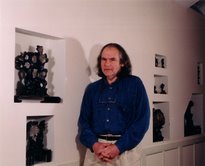
Richard Rosenblum is an American sculptor and outstanding contemporary gongshi collector. Richard has the sensitivity of an artist, great intelligence and an idiosyncratic passion for rocks. He is uncompromising in his pursuit of artistic quality. In addition to writing books on Scholars’ Rocks, Richard’s wonderful collection has toured museums such as the Metropolitan Museum of Art in New York, NY and the Museum of Fine Arts in Boston, MA.
This Essay was written for Kemin Hu’s book The Spirit of Gongshi: Chinese Scholar’s Rocks
March 7th, 2008
‘Scholar’s rock’ is the name commonly given to gongshi in the West. I much prefer the use of ’spirit stone’ as it is more in keeping with the fundamental Chinese appreciation of their spiritual aspects. The term ’spirit stone’ also evokes the deeper Daoist symbolism that was the basis for the original interest among Tang, Song, and Ming literati in these objects. Whereas ’scholar’s rock’ reflects basic tenets of Western connoisseurship which is essentially analytical and investigative. Hence the vital role of provenance and the focus placed on appreciation of man-made objects.
Western study is objective and scientific and generally lacks or downplays the spiritual challenge of Chinese art. Thus it is difficult to appreciate objects in their natural form. New York’s Museum of Modern Art has no natural objects in their collection, and apart from a few spirit stones, The Metropolitan Museum of Art has only man-made objects. Consequently, there is a tendency to regard rocks as geological rather than spiritual objects and to appreciate them by rock type rather than for their aesthetic appeal.
The Daoist principle of pu is particularly relevant to the understanding of gongshi. Pu has been translated as the ‘uncarved block’ implying things in their natural state. To quote from a no less impeccable source than the Tao of Pooh: “The essence of the principle of the ‘uncarved block’ is that things in their own original simplicity contain their own natural power, power that is easily spoiled and lost when that simplicity is changed.”
In support of my viewpoint, let me plagiarize and quote a variety of sources
“These stones evoke a world in miniature, a Daoist paradise.”
“In Chinese experience, mountains and stones were looked upon as the tangible embodiment of the natural order.”
“The purest energy of the heaven/earth world coalesces into rock.”
“The formations are wonderful and fantastic, nature’s wonders hidden in strange places.”
“Stones, a microcosmic imagery of mountains.”
“The stone is not a materialistic representation of a mountain but a symbolic, ideal image.”
“They serve as substitutes for the wonderful landscapes seen in dreams.”
Spirit stones were highly prized as early as the Tang dynasty. For example, Su Shi would only exchange two of his stones for a pair of horse paintings by the Tang master Han Gan. Sun Chengyou, the tenth century Censor of Hangzhou, paid 100 pieces of gold for one stone and in ‘The Ethereal Rock,’ Po Songling, a lover of rocks, recounts that Xing Yunfei was buried with his treasured stone. The literati of ‘Twelve Rock Studio’ stated that the prime, overriding element of appreciation was that a spirit stone must have the characteristics of a painting.
My own view is that the geological composition of a stone and the various attributes listed in a Formulaic Statement dated 1811 cannot be isolated as governing categories of appreciation; it is the essence or wholeness of the unchanged block, or pu, that counts. These material forms were, for the literati, objects of great beauty, strange and significant objects, believed to contain the quintessence of spiritual forces, solidified qi, that served as a reminder of their own humble place in nature.
I think it is both the spiritual dimension of stone appreciation and the general lack of provenance that explain the limited appeal of gongshi in the West. We know that you have to use the mind to enter and penetrate the world of Chinese painting. We know, too, that the whole concept of Chinese art is an intellectual adventure in the appreciation of form and perception. Spirit stones are my intellectual challenge and adventure.
Ian Wilson is an outstanding contemporary gongshi collector, whose collection has been touring museums in the United States and abroad. His collection can be seen in The Spirit of Gongshi: Chinese Scholar’s Rocks
This Essay was written for Kemin Hu’s book The Spirit of Gongshi: Chinese Scholar’s Rocks
March 7th, 2008
I began collecting rocks in my twenties, more than sixty years ago. Ever since, my interest has never diminished. Western painters use human bodies as models while we landscape painters prefer rocks. Human beings, despite differences in appearance, height, proportion and weight, are on the whole not much different from one another. Rocks come from nature, and they are God’s masterpieces, widely different in shape, material, color, texture, and, more importantly, in artistic conception and charm. To depict a rock in a landscape is to paint its bones and frame. A good landscape painter has a profound understanding of the shape and surface texture of a rock.

Chinese painting, both in past and present, focuses on texture and brushwork. Truthful depiction of landscape was valued in ancient Chinese painting from the Five dynasties (907-960) until the Yuan dynasty (1279-1368) when Ni Zan shifted the focus to use of the brush.
Rocks, like paintings, are not restricted by years or given cultures, nor are they confined to the West or the East. They can serve as a bridge that transcends time, space, and culture.
In the early years of my life, I loved the truthful representation of mountains and rivers in a traditional way. later, I came to love abstract landscape paintings that stress the use of ink and brushwork. This change was brought about by revelations from ‘God’. A good abstract landscape should be doubly abstract — offering an image that goes beyond the image of the landscape while expressing the painter’s response to real mountains and hills as he conceives them, a canny inspiration that defies description. It is just like an opera performance in which not only a plot unfolds, but also the music, the sound beyond the words sung by the performers, as well as their feelings based on their interpretation of the characters they portray.
When I collect rocks, I am not concerned with their date or place of origin. My interest lies solely in their beauty, their abstract beauty. The beauty of a rock goes beyond any superficial explanation. I view them as pictures, cubist and abstract pictures. They are God’s creations bestowed upon us.
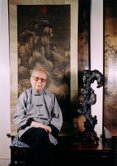
C. C. Wang is a renowned Chinese landscape painter and an outstanding contemporary gongshi collector.
This Essay was written for Kemin Hu’s book The Spirit of Gongshi: Chinese Scholar’s Rocks
March 7th, 2008
It is a time honored practice to display rocks in outdoor gardens or indoors on pedestals for appreciation. The great calligrapher and painter Mi Fu loved rocks to distraction. Bowing to them nearly everywhere he encountered them, he became known as ‘Mi the Eccentric’. The famous poet Su Shi had a passion for rocks as well and composed many beautiful verses about them:
“I returned, carrying this rock with me,
So the Eastern Sea was cradled in my sleeves.”
“The clouds and smoke beyond three mountain peaks
Could all be viewed in a fistful of Ningxian rock.”
These examples attest to the long history of rock appreciation.
Gongshi are selected for their unusual and beautiful shape, good color, and material. Of prime importance are features such as holes (tou), channels (lou), thinness (shou) and wrinkles (zhou) as well as their natural forms. Displayed on plates, basins, pedestals or stands, these rocks, with minor carving, reveal themselves as works of art full of majestic grandeur and refined elegance.
An exquisite rock is a painting by divine hands, a carving made by the gods, with a hundred linked holes, offering a wealth of joy and amusement . Perfect specimens are rarely found and an amateur collector can scarcely dream of obtaining one! Even if you are fortunate enough to own one, it often appears inadequate for a full expression of your artistic conception. One solution is to group rocks together, highlighting their individual merits while avoiding their flaws. Four or five of them of different heights arranged as an ensemble with some miniature trees creates a natural landscape within a limited space, a refreshing artistic conception that suggests the beauty of winding mountains.
Select rocks with similar material and texture for the ensemble. Keep them detached from one another, each with a separate pedestal, so that they can be easily placed and re-arranged on a desk to accommodate changing artistic ideas. I offer a few illustrations of my own groupings for the comments and appreciation of rock lovers.
(This article was privately printed in China before the author’s passing in 1996. We are grateful to Mr. Fang Yingjiu for bringing it to our attention)
Hu Zhaokang (1918 - 1996) is a connoisseur of Chinese antiques and gongshi.
This Essay was written for Kemin Hu?s book The Spirit of Gongshi: Chinese Scholar?s Rocks
March 6th, 2008
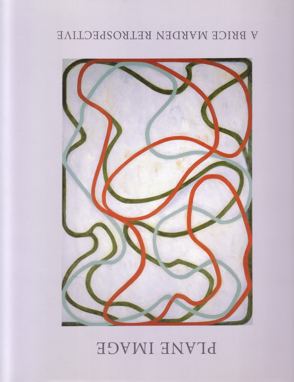
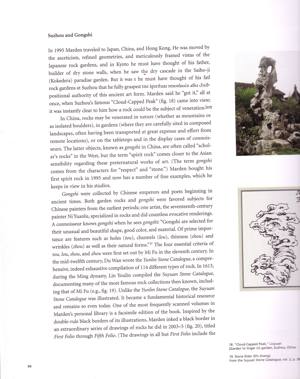
In 1995 Marden traveled to Japan, China, and Hong Kong. He was moved by the asceticism, refined geometries, and meticulously framed vistas of the Japanese rock gardens, and in Kyoto he must have thought of his father, builder of dry stone walls, when he saw the dry cascade in the Saiho-ji (Kokedera) paradise garden. But it was only when he got to China and the rock gardens at Suzhou that he fully grasped the spiritual resonance and compositional authority of this ancient art form. Marden said he “got it,” all at once, when Suzhou’s famous “Cloud-Capped Peak” came into view; it was instantly clear to him how a rock could be the subject of veneration.
In China, rocks may be venerated in nature (whether as mountains or as isolated boulders), in gardens (where they are carefully sited in composed landscapes, often having been transported at great expense and effort from remote locations), or on tabletops and in the display cases of connoisseurs. The latter objects, known as gongshi in China, are often called “scholar’s rocks” in the West, but the term “spirit rock” comes closer to the Asian sensibility regarding these preternatural works of art. (The term gongshi comes from the characters for “respect” and “stone.”) Marden bought his first spirit rock in 1995 and now has a number of fine examples, which he keeps in view in his studios.
The above except is from the book: Plane Image - A Brice Marden Retrospective


February 9th, 2008
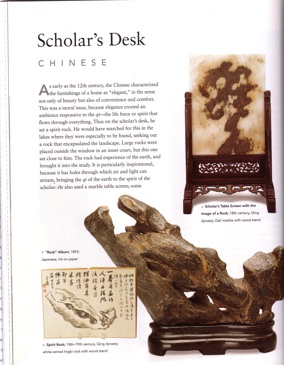
As early as the 12th century, the Chinese characterized the furnishings of a home as “elegant,” in the sense not only for beauty but also of convenience and comfort. This was a moral issue, because elegance created an ambiance responsive to the qi – the life force or spirit that flows through everything. Thus on the scholar’s deck, he set a spirit rock. He would have searched for this in the lakes where they were especially to be found, seeking out a rock that encapsulated the landscape. Large rocks were placed outside the window in an inner court, but this one sat close to him. The rock had experience of the earth, and brought it into the study. It is particularly inspirational, because it has holes through which air and light can stream, bringing the qi of the earth to the spirit of the scholar.
The above except is from the book Sister Wendy’s American Collection

February 9th, 2008