Posts filed under 'Learn about Scholars' Rocks'

Chrysanthemum Stone

Scholar's Rock - Chrysanthemum StonePlace of origin:
Liuyang County, Hunan Province; Enshi County, Hubei Province; Yongfeng County, Jiangxi Province

Mineral composition:
Limestone; cinerea (ash-colored) limestone

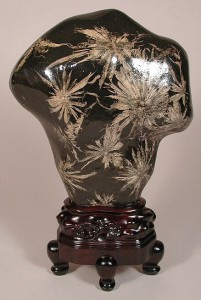
Unique and highly prized among stone collectors, chrysanthemum stones appear to be white flowers embedded in black rock; exhibiting such details as petals and stamen, they look so vivid that many people mistake them for fossilized flowers. In his Elegant Stones (Ya Shi), the contemporary scholar Zhang Hongzhao explains their formation:

“When calcites in the chrysanthemum stone integrate, the stone materials will condense and then solidify toward the center, forming big or small patterns in shapes resembling those of chrysanthemums.”

Although the flowers are naturally formed, only through polishing do they become prominent. In 1915, a chrysanthemum stone hanging screen made in Liuyang won the Gold Award at the International Fair in Panama, which has made this stone type widely popular ever since.

Chrysanthemum stones from different places show slight variations in the shapes of their flowers. The flowers of Liuyang chrysanthemum stones are small but evenly arranged. The chrysanthemum scholars’ rocks and chrysanthemum inkstones available today are all made of Liuyang chrysanthemum stones, although there are inevitably some exceptions. The flowers of chrysanthemum stones from Enshi are large and of different sizes. As well, there is a clearer distinction between the base stone and the bright, pure white flowers. The flowers of chrysanthemum stones from Yongfeng also vary, not only in size but in the patterns of their flowers, and look more like painted pictures. Some of the Yongfeng stones have slight yellow or red color in them.

Since chrysanthemum stones are mountain stones (although some are found in water), some polishing is done to make their colors more distinct. However, the flowers should not be carved into relief (as is sometimes done) and the contact area between the flowers and the stone should be retained so as to emphasize the natural evolution of such stones. Misguided human effort to highlight the flower patterns can lead to unfortunate aesthetic results.

Add comment February 7th, 2008

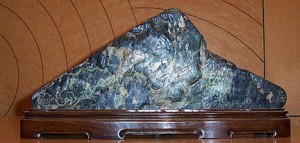
Laoshan Green Stone

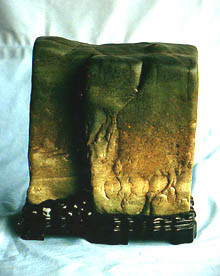
Scholar's Rock - Laoshan Green StonePlace of origin:
Yangkouwan of the Laoshan Mountain, Qiangdao, Shandong Province

Mineral composition:
Serpentine (metamorphic rock); pyrophyllite (a clay composed of aluminum silicate); amphibole (igneous rock)

Laoshan, in Shandong Province, is famous because the makers of Qingdao Beer use the spring water there for brewing. As early as the Song and Yuan dynasties, people collected the green stones found in the sea there as scholars’ rocks. As is recorded in the County Record of Jimo in the Qing Dynasty, Baibi, a miliary officer of Jimo, offered two Laoshan green stones to Emperor Qianlong, who was greatly delighted. Shen Xin, the Qing dynasty compiler of A Record of Grotesque Stones (Guaishi lu) wrote:

“The Laoshan stone is quite hard and the color is like that of an ancient tripod [a bronze ding, which would have had a green patina]. What is lovely is that some of the stones have white streaks, looking like melting snow. Big stones resemble erupting springs, have gullies on them and, when used as ornaments, closely matched Ying stones and Lingbi stones in elegance; small stones, on the other hand, are like yanshan [ink mountain stones].”

Laoshan stones are mainly green, and appear elegant and reserved. Normally, those of deep green color are nicknamed “sea bottom jade” (haidi yu) and those fibrous or crystal stones in light green “sea bottom jadeite” (haidi cui). The latter color usually sets off the former, forming pictures of various kinds, seen as towering peaks, rolling waves, deep green forests, fleeting clouds, lingering fog, or even urban skyscrapers. Since Laoshan stones are hard and produced in Shandong, a province with a stone collecting tradition, people today can still find some Laoshan stones collected many years ago.

Laoshan green stones vary with the depth of the water they are taken from. Those from shallow water are more fibrous in form due to their feathery crystal formation, while those from deep water are hard as jade, more compact and bulky due to the greater water pressure. It is marvelous to see jade green color on the surface of a deep green stone.
Add comment February 7th, 2008

Modern Chinese Scholars’ Rocks - A Guide for Collectors

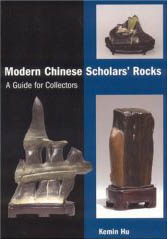
Modern Chinese Scholars' Rocks - A Guide for Collectors by Kemin HuModern Chinese Scholars’ Rocks - A Guide for Collectors
By Kemin Hu

Through descriptions and color photographs, Modern Chinese Scholars’ Rocks introduces 50 stone types, including their mineral compositions, typical colors, hardness on the Mohr scale, and where they are found or quarried. Also included in this book are ways to position stones, choosing the right stand and right display, craftsmanship of stand making, and more.

$29.95 - Signed by Kemin Hu (order now)
Floating World Editions, 2006
8.5″ x 11″, Soft Cover

Other Books on Scholars’ Rocks by Kemin Hu

2 comments February 7th, 2008

The Suyuan Stone Catalogue: Scholars’ Rocks in Ancient China

The Suyuan Stone Catalogue: Scholars? Rocks in Ancient China by Kemin HuThe Suyuan Stone Catalogue: Scholars’ Rocks in Ancient China
by Kemin Hu

This is one of the most comprehensive and important texts on the collection and appreciation of scholars’ rocks (gongshi) in ancient China. The selections included here, the first to be published in English, are presented with insightful commentary and over 188 wood-block and full-color illustrations, creating an invaluable reference book for all those interested in traditional Chinese aesthetics, gardens, penjing, or simply the brilliant art of nature.

$50 Signed by Kemin Hu (order now)
Weatherhill, 2002
156 pages. 8.5″ x 11″, Hard Cover

Other Books on Scholars’ Rocks by Kemin Hu:

4 comments February 7th, 2008

The Spirit of Gongshi: Chinese Scholar’s Rocks

The Spirit of Gongshi: Chinese Scholar's Rocks By Kemin HuThe Spirit of Gongshi: Chinese Scholar’s Rocks
By Kemin Hu

With essays by Ian Wilson, Richard Rosenblum, C.C. Wang, and Hu Zhaokang. This column is a survey of Chinese Scholar’s Rocks from important private collections in America and China. Over 200 color illustrations, text in English and Chinese.

$40 Signed by Kemin Hu (order now)
Paragon, 1998
128 pages. 8.5″ x 11″, Soft Cover

Other Books on Scholars’ Rocks by Kemin Hu:

1 comment February 7th, 2008

Art of the Natural World: Resonances of Wild Nature in Chinese Sculptural Art

Art of the Natural World: Resonances of Wild Nature in Chinese Sculptural Art

Art of the Natural World: Resonances of Wild Nature in Chinese Sculptural Art
By Richard Rosenblum

This volume offers a meditation by the noted artist and collector Richard Rosenblum on the philosophy and spirit of Chinese art of the natural world, from scholars’ rocks to related objects in wood, metal, and ceramic - as well as such reverse manifestations as works sculptured to replicate natural art.

$35 MFA Publications, 2001
157 pages. 7.5″ x 10.5″, Hard Cover

Add comment February 7th, 2008

Next Posts Previous Posts


Newest Stones in Galleries

Three Gorges Stone Qixia Stone Linglong Ying Stone Lingbi Stone Calico Lingbi Stone Laoshan Green Stone Ying Stone Lingbi Stone Calico Lingbi Stone

Scholar's Rock Galleries

Welcome to Spirit-Stones.com

Scholar's Rock Categories