Posts filed under 'Learn about Scholars' Rocks'
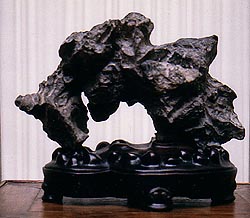
Wen rocks are found in Zibo, Shandong province. They are decayed rocks composed of lime, granite or clay stone. Aesthetically wen rocks have a naturalness and antique simplicity. They have a weathered look with dots or crossing lines on the surface and a variety of wrinkled forms. Among this type are aragonite rocks which are usually black and very hard. Wen rocks portray a feeling of “pu.”
February 7th, 2008
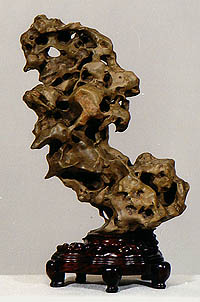
Yellow wax rocks are found in many places in China including Guangdong, Guanxi, and Ganxu but not in great quantity. Their gentle shape and smooth texture is neither thin nor perforated, but dense. Composed either of andesite with silica or sandstone, they seem hard as jade. A distinctive feature of yellow wax rocks is their purity of color.
February 7th, 2008
Place of origin:
Hami, Xinjing Province; Beijing, Liaoning Province; Zhejiang Province
Mineral composition:
Elements resulting from silicification, ironization, and calcification
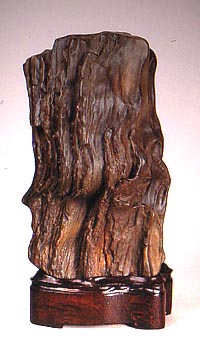
Muhuashi derives from wood buried in the earth a hundred million years ago that has silicified over time, a process that yields some good stones for the studio. Xylon in the wood has been replaced by silicon dioxide (SiO2), but the wood texture remains. Petrified wood is quite hard and most are brown or yellowish brown. They have a jade-like feel and were objects of appreciation as early as the Tang dynasty. There are two examples of petrified wood collected in the Ming dynasty in Zhejiang province.
February 7th, 2008
Place of origin:
Deserts of Inner Mongolia and Hami, Xinjiang
Mineral composition:
Quartz, agate, jasper, protein, chalcedony
Obtained in the provinces of Xinjiang, Inner Mongolia, and the Gobi desert of Ganxu, fengli are stones that have been naturally ground or worn down by the action of wind and sand or subsurface heat. They are usually less than 20 centimeters across. Their diverse shapes are due in part to their size: smaller stones are more likely to be subjected to the action of these natural forces. They may be composed of agate, jade, opal, quartz, or crystal, and the differences in their mineral content account for their variety of color. Fengli are usually white, grey, red, or brown. Beautifully shaped, they are admired for their variety and striking texture.
February 7th, 2008
Place of origin:
Caitao Red River Stones - Red River of Heshan, Guangxi Province
Dahua Red River Stones - Red River of Dahua County, Guangxi Province
Mineral composition:
Siliceous rock
These rocks are composed primarily of quartz and are found in the Red Water River of Guanxi province. There has been a growing demand for them from Southeast Asian collectors however in recent years good examples could only be found in the riverbed twenty meters below the surface, not in shallow waters. As a result of their scarcity, there are few opportunities to see them in the West. They will however surely attract more attention in the future.
February 7th, 2008
Place of origin:
Yufeng Mountain in Kunshan City, Jiangsu Province
Mineral composition:
Dolomite and silicilate
Produce in Kunshan, Jiangsu province, Kun rocks are made of berg crystal formed in dolomite from siliceous liquid that filled the holes and tissues of the rock. To make them suitable for display is quite complex. The quality of Kun rocks only becomes evident after prolonged exposure to the sun for five to six days followed by repeated washing of the mud in the holes. After hundreds of years of extraction, they have become quite rare and successive governments have banned their mining for fear of mountain erosion.
February 7th, 2008
Next Posts
Previous Posts