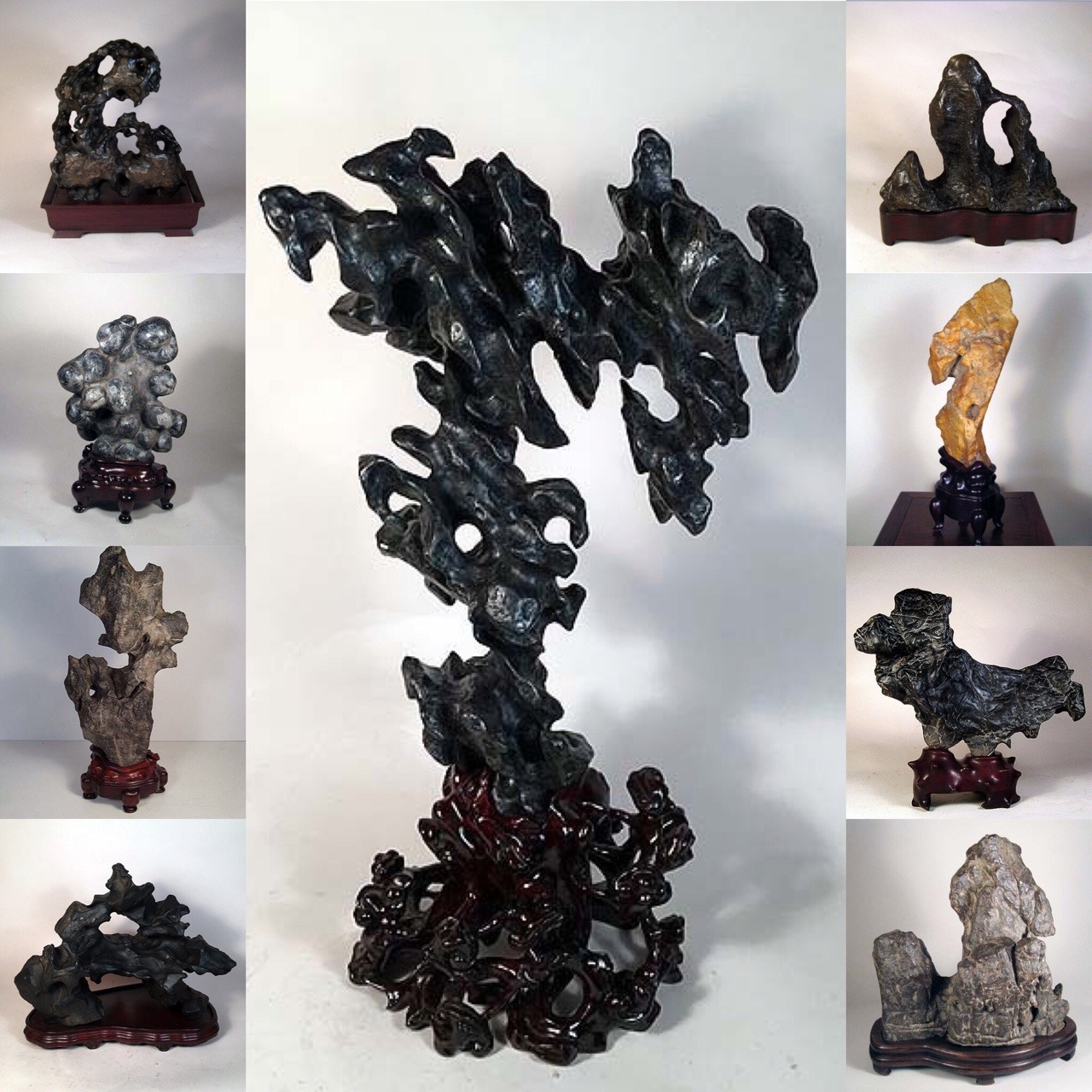
Shou Zhou Lou Tou (SZLT)
The great Song literati Mi Fu formed an appreciation of rocks based on his own aesthetics as well as what he knew of past collections. The four categories he considered essential to the appreciation of rocks were shou, zhou, lou, and tou. These four criteria are still used by connoisseurs today, especially for Taihu rocks.
Shou means thin and with respect to rocks, it means an elegant, slender shape, ‘vertically oriented, erect and alone’. (see Figure 1)
Zhou means wrinkles and refers to rich surface textures and furrows created from delicate intaglio lines and relief ridges that show rhythms and changes in shape. Thus a small rock can embody the topographic features of hills and mountains. (see Figure 2) In Hangzhou, the rock known as ‘Wrinkling Cloud Peak’ combines both shou and zhou. (see Figure B)
Lou means channels and other types of indentations that lend an exquisite beauty to rocks. These channels are linked to one another as if a path were unfolding itself through the rock. (see Figure 3)
Tou means holes and openness. Air and moonlight can pass through such openings. (see Figure 4) In Shanghai, the rock known as ‘Exquisite Jade’ combines both lou and tou. (see Figure A)

Figure A - ‘Equisite Jade’ Figure B - ‘Wrinkling Cloud Peak’

Figure 1 Figure 2 Figure 3 Figure 4
February 21st, 2008
Shape, Material, Color, Spirit
Although Mi Fu’s four categories are well-suited for describing Taihu Rocks, they are not comprehensive enough, and with the appearance of newer gongshi types, modern connoisseurs generally apply another set of criteria for judging rocks. These four are shape (xing), material (zhi), color (se), and spirit (shen).
Shape (xing)
The first consideration for a rock is that it should be naturally shaped. Display rocks can then be divided into two groups: abstract and representational. The former gives more room for the imagination and are admired by many people. But rock lovers also appreciate representational rocks which can be subdivided into those representing landscape and those representing particular objects. Landscape representational rocks resemble hills, scenes after snow, cliffs and peaks. They can be further subdivided into those representing near or far distant scenes. The latter should exhibit proportion between height and width to give a proper framework for the vista represented. Rocks resembling particular objects, such as human figures and animals may either bear such likeness in shape or spirit. The merit of the latter is that they both resemble and yet do not resemble a given object.
(more…)
February 20th, 2008
A Chinese saying has it that, “A garden without scholars’ rocks cannot be beautiful, and a room without a scholars’ rock lacks elegance.” To make the studio, or any creative or meditative space, elegant and “shine,” to quote the famous Song calligrapher Mi Fu (1051-1107), a scholars’ rock appropriately displayed is an essential decorative element. As a general rule, scholars’ rocks can be displayed in the same manner as other sculptural pieces. However, an important additional consideration stems from the fact that scholars’ rocks are a natural art form, intimately connected with the formation of the earth and thus a witness to all history. As such, a scholars rock brings a spiritual dimension to its environment and this dimension should be allowed to be readily appreciated, even enhanced…
Here’re a few pictures and we encourage you to submit pictures of your scholars’ rock in your home or office to share!


More examples of Displaying Scholars’ Rocks
February 10th, 2008
In 1995 Marden traveled to Japan, China, and Hong Kong. He was moved by the asceticism, refined geometries, and meticulously framed vistas of the Japanese rock gardens, and in Kyoto he must have thought of his father, builder of dry stone walls, when he saw the dry cascade in the Saiho-ji (Kokedera) paradise garden. But it was only when he got to China and the rock gardens at Suzhou that he fully grasped the spiritual resonance and compositional authority of this ancient art form. Marden said he “got it,” all at once, when Suzhou’s famous “Cloud-Capped Peak” came into view; it was instantly clear to him how a rock could be the subject of veneration.
In China, rocks may be venerated in nature (whether as mountains or as isolated boulders), in gardens (where they are carefully sited in composed landscapes, often having been transported at great expense and effort from remote locations), or on tabletops and in the display cases of connoisseurs. The latter objects, known as gongshi in China, are often called “scholar’s rocks” in the West, but the term “spirit rock” comes closer to the Asian sensibility regarding these preternatural works of art. (The term gongshi comes from the characters for “respect” and “stone.”) Marden bought his first spirit rock in 1995 and now has a number of fine examples, which he keeps in view in his studios.
The above except is from the book: Plane Image - A Brice Marden Retrospective


February 9th, 2008
As early as the 12th century, the Chinese characterized the furnishings of a home as “elegant,” in the sense not only for beauty but also of convenience and comfort. This was a moral issue, because elegance created an ambiance responsive to the qi – the life force or spirit that flows through everything. Thus on the scholar’s deck, he set a spirit rock. He would have searched for this in the lakes where they were especially to be found, seeking out a rock that encapsulated the landscape. Large rocks were placed outside the window in an inner court, but this one sat close to him. The rock had experience of the earth, and brought it into the study. It is particularly inspirational, because it has holes through which air and light can stream, bringing the qi of the earth to the spirit of the scholar.
The above except is from the book Sister Wendy’s American Collection

February 9th, 2008
From the National Bonsai Foundation website (http://www.bonsai-nbf.org/site/viewing_stones.html)
 |
Chinese Scholar?s Rock - Taihu stone
From Lake Tai, Jiangsu Province, China
83 x 38 x 30 cm
Donated by Kemin Hu, 2000
Photo: Joe Mullan |
 |
Chinese Scholar?s Rock - Lingbi stone
From Lingbi, Anhui Province, China
73 x 34 x 20 cm
Donated by Kemin Hu, 2000
Photo: Joe Mullan |
February 7th, 2008
Next Posts
Previous Posts